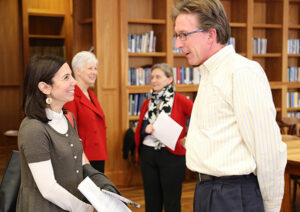
Two UGA faculty members engage in discussion.The Center for Teaching and Learning offers UGA faculty and post-doctoral scholars the opportunity for cohort-based instructional development through its Faculty Learning Communities (FLCs) program.

A Faculty Learning Community is a specifically structured community of practice that includes the key goals of building community, engaging in scholarly (evidence-based) teaching, and the development of the Scholarship of Teaching and Learning (Cox & Richlin, 2004). The CTL provides funds for each FLC to support community activities. FLCs may have as few as six or as many as sixteen participants. Participants meet approximately once every three weeks during the academic year.

CTL FLCs have the additional goal of sharing the outcomes of their discussions with the larger teaching and learning community (either at UGA or beyond). This FLC Engagement Project (the FLC EP) might take many forms, such as a CTL workshop, resources for instructors at UGA, the development of curriculum to be implemented in academic courses at UGA, the submission of a journal article, a conference presentation, etc.

2025-2026 Faculty Learning Communities

(unless otherwise indicated, each FLC will select meeting times based on what works best for members of their group)

Capstone Courses across Campus

Facilitated by Jorge Ivan Rodriguez Devora

The Capstone Initiative brings capstone instructors and coordinators together to help develop an understanding of the various upper-level project-based courses offered at UGA. We will identify and promote best practices for project-based courses and explore the opportunity of forming collaborative projects between the different capstone programs. Discussion in this FLC promise to enhance the student experience in these capstone courses and enable UGA to solicit larger/multidisciplinary projects for them by leveraging the expertise of not only a particular college or major but also the entire University of Georgia.

Course Design Made Easy

Facilitated by Adrian Burd & Sarah Robinson

Designing a course can be hard work and time consuming. How do you design a course that both promotes student learning and is easy on your time? This FLC is aimed at faculty who are interested in learning about proven, evidence-based methods of designing a course that both promotes student learning and is easy on your time as an instructor. Together, we will explore, discuss, and learn about Backwards Course Design, Learner-Centered Course Design, Universal Design for Learning and other well-established course-design strategies. This FLC is for you if you are contemplating designing a new course, or re-designing an existing one, or simply interested in exploring course-design strategies. This FLC will meet on select Tuesdays or Thursdays.

**This FLC will meet on Tuesdays/Thursdays every 2-3 weeks (at a time agreed upon by members)

Developing Dialogic Classrooms for Authentic Engagement

Facilitated by Don Nelson & Brandy Walker

Authentic learning happens best when students are engaged in learning environments that foster reflection, purposeful dialogue, and the ability to ask questions of genuine inquiry. This FLC seeks faculty interested in sharing their experiences with dialogically organized instruction and dialogic teaching, and proposes to explore ways to develop dialogic classrooms. Faculty from all disciplines are invited to join the discussion. FLC meetings will include professional development on the practice of reflective structured dialogue and the practical application of dialogic elements in pedagogy, as well as the exploration of literature on dialogic practices in higher education.

Improvisation for Teaching and Learning

Facilitated by Jennifer Marks, Ryan Carroll, & Jonathan Haddad

To be effective, educators must not only master their discipline, but must also learn how to communicate with their students. They must deeply listen, engage appropriately, participate in the moment, and think on their feet. Not surprisingly, these same communication skills are essential to the work of the student as well. Improvisational theatre is an approach that has been used in many settings to promote and improve robust communication skills. This FLC will provide an orientation for improv techniques for faculty new to improvisational theatre as well as giving more experienced faculty a forum to expand on their skills. As a locus for both experiential work and discussion, the FLC will explore how the theory and practice of improvisational skills apply to pedagogy, critical thinking skills, and creativity.

Lab Partner Board Games

Facilitated by Brian Kvitko, Marshall Shepherd, & Eric Rubenstein

One way for science educators to teach challenging subjects is by creating fun and engaging educational games, either for general or classroom use. However, there are many skills needed and logistical issues to be considered for effectively translating an initial game concept into a successful and accessible board game. The Lab Partner Board Games FLC will bring together faculty interested in creating or exploring the use of board games for use in the teaching and learning space. We’ll work together to walk through key phases of the design process, including initial conception, board game design, integration into specific course design, and testing and piloting ideas with students. Members of our Lab Partners Board Game FLC will also be available to consult on key details involved in the process of game development.

Mentoring at UGA: The Essentials

Facilitated by Bethany Bagwell

Join this FLC for opportunities to share and discuss evidence-based mentoring best practices, continue our ongoing project of developing and launching a mentoring eLC course for faculty and staff, and to generally foster a culture of mentoring across the university. Our goal is to provide resources and best practices in support of mentorship across UGA, including with support for NSF grants, and encourage anyone interested to join us!

Non-Tenure-Track Faculty

Facilitated by Sarah Jantzi & Lynn Abdouni

This ongoing FLC continues to work on action items supporting faculty in non-tenure-track (NTT) roles (e.g., lecturer, academic professional, clinical faculty, public service, research scientist, librarian, etc.). Building on prior years’ work, the FLC will focus this year on topics including supporting new NTT faculty, building community, supporting a mentoring program, coordinating dossier writing groups, reviewing relevant UGA and USG policies, and providing relevant and up-to-date information through the website, nontenuretrack.uga.edu.

Reimagining World Language Teaching & Assessment

Facilitated by Lou Tolosa-Casadont

Are you ready to dispose of your grammar-based approaches to world language teaching and assessment and embark in a more communicative way of teaching and assessing language? If so, come join this group of like-minded individuals. During our FLC meetings we will…

  • brainstorm communicative approaches to enliven our novice language courses and help learners engage in more meaningful ways with the language, culture, and each other,
  • put them into practice,
  • gather student feedback and share reflections on student outcomes measured and observed as a result of implementing these new approaches in our classes, and
  • consider the ways in which engaging with our classes helps learners be better prepared, communicatively and culturally, for their future lives.

An additional goal of this FLC is to increase the number of students who minor and major in the languages we offer.

Service-Learning Research & Scholarship for Seasoned Practitioners

Facilitated by Jon Calabria & Kathy Thompson

The Service-Learning Research & Scholarship FLC supports seasoned faculty participants in advancing scholarship around academic service-learning pedagogy and community engagement. Participants should have seasoned experience with many service-learning/community-engaged teaching. Building on our published findings in the Journal of Higher Education Outreach & Engagement (April 2025) and our presentations at the Engagement Scholarship Consortium, Gulf-South Summit, and USG Teaching & Learning Conference, we will:

  1. Apply a comprehensive three-faceted resilience framework (internal, interpersonal, external) to analyze our existing student reflection data
  2. Identify which specific elements of service-learning experiences most effectively develop each facet of student resilience
  3. Map the relationship between service-learning course design features and the development of specific resilience facets
  4. Develop evidence-based recommendations for faculty on how to design service-learning experiences that intentionally foster all three dimensions of resilience
  5. Prepare additional scholarly publications and conference presentations that specifically address these three facets of resilience in service-learning contexts.

**This FLC will meet on Tuesdays at 4 p.m. in the Georgia Center, approximately every three weeks

Sustainability: Climate Change Across the Curriculum

Facilitated by Tyra Byers & Jason Roberts

This FLC will bring together interdisciplinary faculty to explore teaching sustainability with a focus on climate change. We will use our own courses as examples and opportunities for curriculum development and piloting new strategies, while broadening our own understanding of education and sustainable communities. We will explore the many ways different disciplines can engage in this topic with an emphasis on the sharing and development of resources, opportunities for collaboration, and local application of global challenges.

Teaching with Incarcerated Learners: An Interest Group

Facilitated by Sarah Shannon & Jean Martin-Williams

Have you ever pondered teaching in correctional settings (e.g., prisons, jails)? This FLC is for faculty with a strong interest in (and/or experience with) teaching justice-involved people. Our work will include forming / strengthening partnerships with correctional agencies, guiding faculty new to this arena towards proven pedagogies and structures, especially Common Good Atlanta and Inside Out. We also aim to provide education to the broader UGA community about the benefits of prison education. More information is available on our College & Corrections website.

Teaching with Museum Collections

Facilitated by Akela Reason

This FLC explores object-based learning (OBL) methods using museum collections across the campus (and beyond). OBL involves the close study of tangible artifacts as a means of drawing conclusions about a topic of study. The method employs direct observation and sensory engagement with a physical object. This FLC welcomes faculty from a range of disciplines who have used collections in the past or who would like to use them in the future and who are interested in learning about how OBL can be employed in academic teaching. In this FLC, faculty will become more familiar with campus collections and with OBL methods. The Fall semester will explore the range of collections on campus and learn OBL methodologies. In the Spring semester, we will put those methods into practice through the development of course assignments that can be implemented in the classroom.

Read through history: check out our past FLCs, 2007-present.

Questions?

For more information about CTL’s Faculty Learning Communities, contact Feli Hartung.